הצגת רשומות עם תוויות Obama. הצג את כל הרשומות
הצגת רשומות עם תוויות Obama. הצג את כל הרשומות
יום שבת, 17 באוקטובר 2015

יום חמישי, 15 באוקטובר 2015
The Obama kill chain Cain
HE DOCUMENTS COME FROM a Pentagon study, circulated in early 2013, evaluating the intelligence and surveillance technology behind the military’s Joint Special Operations Command (JSOC) killing campaign in Yemen and Somalia in 2011 and 2012.
The study, carried out by the Pentagon’s Intelligence, Surveillance, and Reconnaissance Task Force, illuminates and in some cases contradicts the administration’s public description of a campaign directed at high-level terrorists who pose an imminent threat to the United States. It admits frankly that capturing terrorists is a rare occurrence and hints at the use of so-called signature strikes against unknown individuals exhibiting suspicious behavior.
The Intercept obtained two versions of the study, a longer presentation dated February 2013, and an executive summary from May 2013, which includes a slide showing the chain of command leading to the approval of a lethal strike.

A slide from a May 2013 Pentagon presentation shows the chain of command for ordering drone strikes and other operations carried out by JSOC in Yemen and Somalia.
GCC = Geographic Combatant Command; SECDEF = Secretary of Defense; PDC/PC = Principals’ Deputies Committee/Principals Committee; CoM = Chief of Mission; CoS = Chief of Station
The Obama administration has been loath to declassify even the legal rationale for drone strikes — let alone detail the bureaucratic structure revealed in these documents. Both the CIA and JSOC conduct drone strikes in Yemen, and very little has been officially disclosed about either the military’s or the spy agency’s operations.
“The public has a right to know who’s making these decisions, who decides who is a legitimate target, and on what basis that decision is made,” said Jameel Jaffer, deputy legal director of the American Civil Liberties Union.
Both the Pentagon and the National Security Council declined to respond to detailed questions about the study and about the drone program more generally. The NSC would not say if the process for approving targets or strikes had changed since the study was produced.
TWO STEPS TO A KILL
The May 2013 slide describes a two-part process of approval for an attack: step one, “‘Developing a target’ to ‘Authorization of a target,’” and step two, “‘Authorizing’ to ‘Actioning.’” According to the slide, intelligence personnel from JSOC’s Task Force 48-4, working alongside other intelligence agencies, would build the case for action against an individual, eventually generating a “baseball card” on the target, which was “staffed up to higher echelons — ultimately to the president.”
The intelligence package on the person being targeted passed from the JSOC task force tracking him to the command in charge of the region — Centcom for Yemen, and Africom for Somalia — and then to the Joint Chiefs of Staff, followed by the secretary of defense. It was then examined by a circle of top advisers known as the Principals Committee of the National Security Council, and their seconds in command, known collectively as the Deputies Committee.
The slide detailing the kill chain indicates that while Obama approved each target, he did not approve each individual strike, although news accounts have previously reported that the president personally “signs off” on strikes outside of Afghanistan or Pakistan. However, the slide does appear to be consistent with Obama’s comment in 2012 that “ultimately I’m responsible for the process.”

Illustrations: The Intercept
Photo: Feierstein: Landov; all other photos: Getty Images
Photo: Feierstein: Landov; all other photos: Getty Images
There have been various accounts of this drone bureaucracy, and almost all stress the role of Obama’s influential counterterrorism adviser John Brennan (who became director of the CIA in 2013) and of top administration lawyers in deciding who could be killed. Under Brennan, the nominations process was reportedly concentrated in the White House, replacing video conferences once run by the Joint Chiefs of Staff and elevating the role of the National Counterterrorism Center in organizing intelligence. Later in 2013, the White House reportedlytightened control over individual strikes in Yemen.
At the time of the study, with the president’s approval, JSOC had a 60-day window to hit a target. For the actual strike, the task force needed approval from the Geographic Combatant Command as well as the ambassador and CIA station chief in the country where the target was located. For a very important target, such as al Qaeda-linked preacher Anwar al Awlaki, who was a U.S. citizen, “it would take a high-level official to approve the strike,” said Lt. Col. Mark McCurley, a former drone pilot who worked on operations in Yemen and recently published a book about his experiences. “And that includes a lot of lawyers and a lot of review at different levels to reach that decision. We have an extensive chain of command, humans along the whole link that monitor the entire process from start to finish on an airstrike.” The country’s government was also supposed to sign off. “One Disagrees = STOP,” the slide notes, with a tiny red stop sign.
In practice, the degree of cooperation with the host nation has varied. Somalia’s minister of national security, Abdirizak Omar Mohamed, told The Intercept that the United States alerted Somalia’s president and foreign minister of strikes “sometimes ahead of time, sometimes during the operation … normally we get advance notice.” He said he was unaware of an instance where Somali officials had objected to a strike, but added that if they did, he assumed the U.S. would respect Somalia’s sovereignty.
By 2011, when the study’s time frame began, Yemen’s president Ali Abdullah Saleh was in crisis. Facing domestic protests during the Arab Spring, he left the country in June 2011 after being injured in a bombing. Both the CIA and JSOC stepped up their drone campaigns, which enjoyed vocal support from Saleh’s eventual successor, Abdu Rabbu Mansour Hadi.
“It was almost never coordinated with Saleh. Once Hadi became president, March 2012, there was a big chance we’d be in the loop” before drone strikes were conducted, said a former senior Yemeni official who worked for both the Saleh and Hadi governments.
Today, with Yemen’s capital under the control of the Houthi rebel group and undergoing bombardment by Saudi Arabia, administration lawyers do not seem worried about asking permission to carry out drone strikes amid the fray.
“Now, I think they don’t even bother telling anyone. There is really no one in charge to tell,” said the former Yemeni official, who requested anonymity citing current unrest and the fact that he no longer works for the government.
WHO CAN BE TARGETED
Both the Bush and Obama administrations have maintained that the 2001 Authorization for Use of Military Force, or AUMF, permits the pursuit of members of al Qaeda and its affiliates wherever they may be located.
The Pentagon study refers throughout to operations that fall under AUMF. But it also underlines how the targeted killing campaigns differ from traditional battlefields, noting that the region is located “Outside a Defined Theater of Active Armed Conflict,” which limits “allowable U.S. activities.”
Obama administration officials have said that in addition to being a member of al Qaeda or an associated force, targets must also pose a significant threat to the United States. In May 2013, facing increasing pressure to fully admit the existence of the drone war and especially to address allegations of civilian harm, the White House released policy guidelines for lethal counterterrorism operations that seemed to further restrict them. In a speech, Obama announced that action would be taken only against people who posed a “continuing, imminent threat to the American people,” and who could not be captured. A strike would only occur with “near certainty” that no civilians would be killed or injured.
Even with the new guidelines, legal observers, particularly human rights lawyers, have disputed the Obama administration’s position that the U.S., in strict legal terms, is in an armed conflict with al Qaeda in Yemen or Somalia — and therefore dispute what standards should apply to strikes. Others question the extent to which the hundreds of people killed in drone strikes in those countries meet the supposedly strict criteria.
“I think there can be questions raised about how stringently some of the requirements are being applied,” said Jennifer Daskal, an assistant professor of law at American University who worked for the Department of Justice from 2009 to 2011. “Near certainty of no civilian deaths, is that really imposed? What does it mean for capture not to be feasible? How hard do you have to try?”
It is not clear whether the study reflects the May policy guidance, since it does not give an extensive description of the criteria for approving a target, noting only that the target must be “a threat to U.S. interest or personnel.”
A spokesperson for the National Security Council would not explain why the standards in the study differed from the guidelines laid out in May 2013, but emphasized that “those guidelines remain in effect today.”
The two-month window for striking, says Hina Shamsi, director of the ACLU’s National Security Project, shows the administration’s broad interpretation of “a continuing, imminent threat.”
“If you have approval over a monthslong period, that sends the signal of a presumption that someone is always targetable, regardless of whether they are actually participating in hostilities,” said Shamsi.
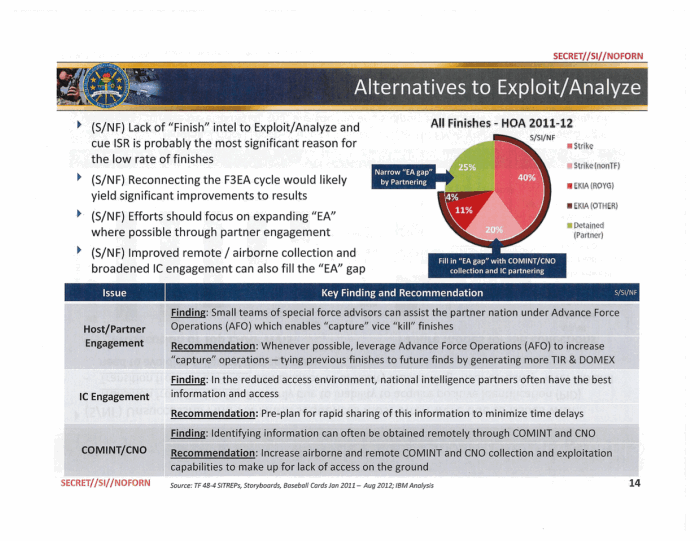
The slide illustrating the chain of approval makes no mention of evaluating options for capture. It may be implied that those discussions are part of the target development process, but the omission reflects the brute facts beneath the Obama administration’s stated preference for capture: Detention of marked targets is incredibly rare.
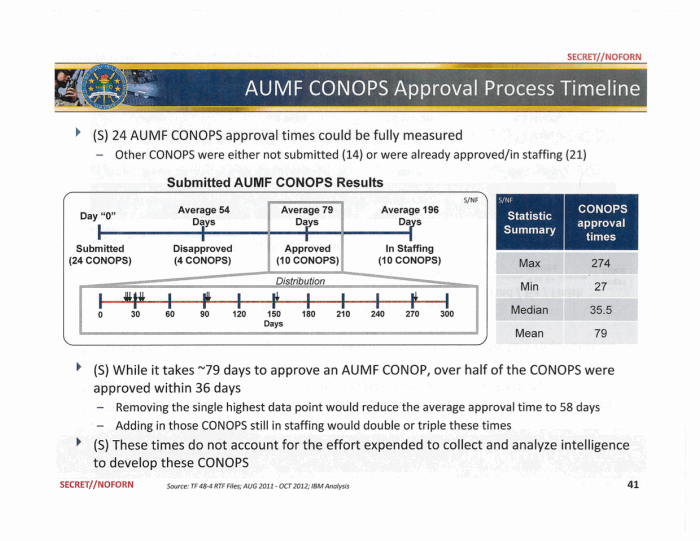
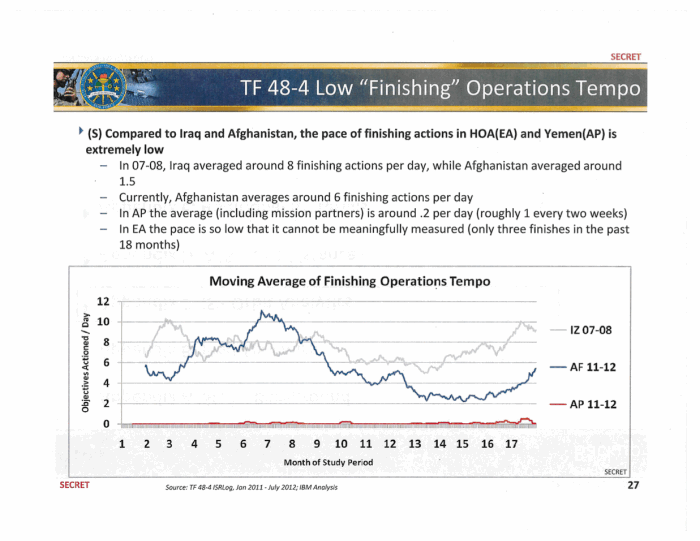
A chart in the study shows that in 2011 and 2012, captures accounted for only 25 percent of operations carried out in the Horn of Africa — and all were apparently by foreign forces. In one of the few publicized captures of the Obama presidency, al Shabaab commander Ahmed Abdulkadir Warsame was picked up in April 2011by U.S. forces in the Gulf of Aden and brought to Manhattan for trial, though he may not be reflected in the study’s figures because he was apprehended at sea.

The Pentagon study recommended more captures, rather than killings, because of the intelligence that could be gleaned from interrogations and collected materials.
EKIA = Enemy Killed in Action; HOA = Horn of Africa
The study does not contain an overall count of strikes or deaths, but it does note that “relatively few high-level terrorists meet criteria for targeting” and states that at the end of June 2012, there were 16 authorized targets in Yemen and only four in Somalia.
Despite the small number of people on the kill list, in 2011 and 2012 there were at least 54 U.S. drone strikes and other attacks reported in Yemen, killing a minimum of 293 people, including 55 civilians, according to figures compiled by the Bureau of Investigative Journalism. In Somalia, there were at least three attacks, resulting in the deaths of at minimum six people.
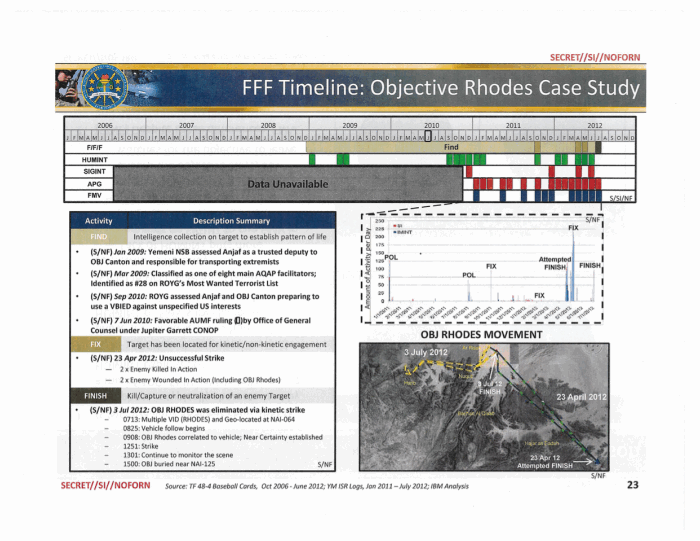
Some of those Yemen strikes were likely carried out by the CIA, which since mid-2011 has flown drones to Yemen from a base in Saudi Arabia and reportedly hasits own kill list and rules for strikes. Yet it is also clear that the military sometimes harmed multiple other people in trying to kill one of those high-level targets. The study includes a description of the hunt for an alleged al Qaeda member referred to as “Objective Rhodes” or “Anjaf,” who is likely Fahd Saleh al-Anjaf al-Harithi, who was reported killed in July 2012, on the same day as Objective Rhodes. A failed strike on Harithi that April killed two “enemies.” News accounts at the time reported three “militants” had died.

A slide from February 2013 recounts the hunt for an alleged al Qaeda member (likely Fahd Saleh al-Anjaf al-Harithi) showing that two others died in a botched attempt to kill him.
The large number of reported strikes may also be a reflection of signature strikes in Yemen, where people can be targeted based on patterns of suspect behavior. In 2012, administration officials said that President Obama had approved strikes in Yemen on unknown people, calling them TADS, or “terror attack disruption strikes,” and claiming that they were more constrained than the CIA’s signature strikes in Pakistan.
The study refers to using drones and spy planes to “conduct TADS related network development,” presumably a reference to surveilling behavior patterns and relationships in order to carry out signature strikes. It is unclear what authorities govern such strikes, which undermine the administration’s insistence that the U.S. kills mainly “high-value” targets.
NEAR CERTAINTY
According to the White House guidelines released in May 2013, the decision to take a strike should be based on thorough surveillance and only occur in the absence of civilians. A strike requires “near certainty that the terrorist target is present” and “near certainty that non-combatants will not be injured or killed.”
The study describes the rules for a strike slightly differently, stating that there must be a “low CDE [collateral damage environment]” — meaning a low estimate of how many innocent people might be harmed. It also states there must be “near certainty” that the target is present, “based on two forms of intelligence,” with “no contradictory intelligence.” In contrast to the White House statement, the “near certainty” standard is not applied to civilians.
The study cites the “need to avoiding [sic] collateral damage areas” as a reason for “unsuccessful” missions, but it does not give numbers of civilian casualties or examples of bad intelligence leading to a mistaken kill.

Since the first drone strike in Yemen in 2002, hundreds of people have been killed in U.S. operations in Yemen and Somalia, many of them innocent civilians. The tallies shown here were compiled by the Bureau of Investigative Journalism from reports of both CIA and JSOC drone strikes and other operations. The large range in the estimates is due to the inherent difficulties of collecting data on airstrikes in war zones. The identities of the “people killed” were often unknown and may include civilians as well as suspected terrorists or militants. The U.S. almost never publicly acknowledges individual operations.
Graphic: The Intercept
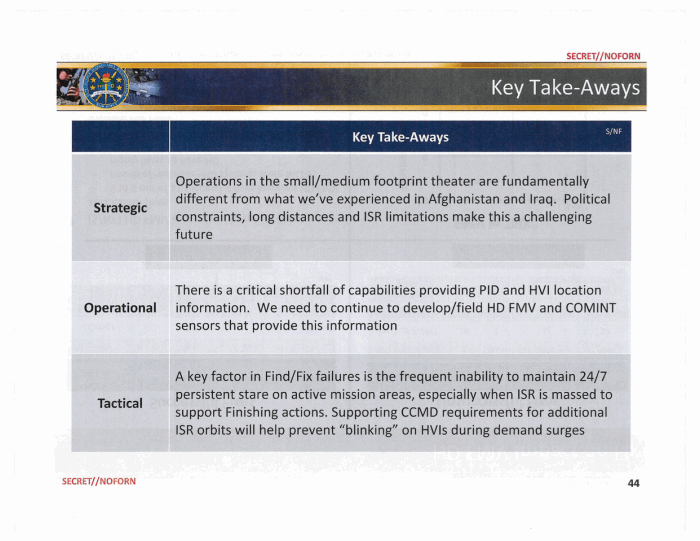
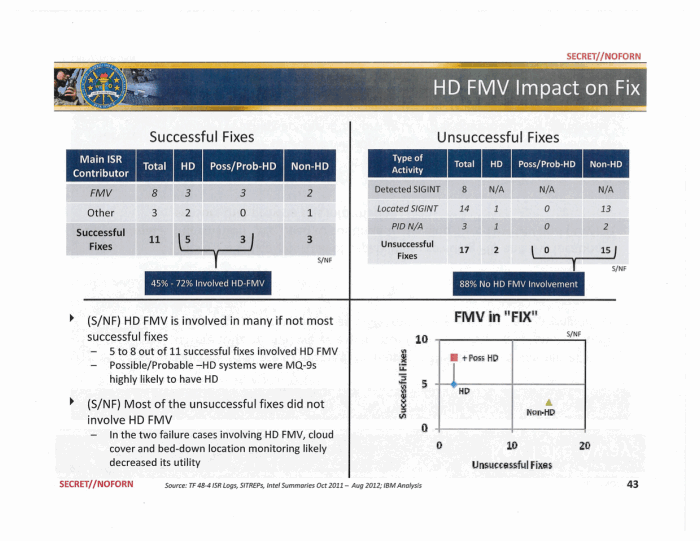
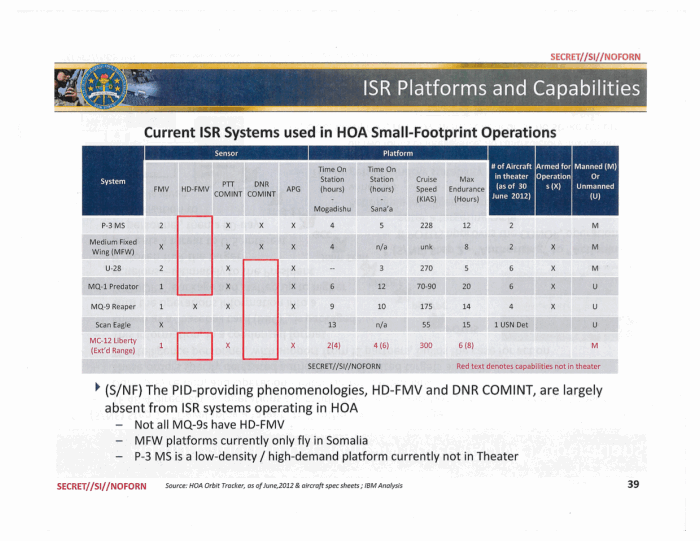
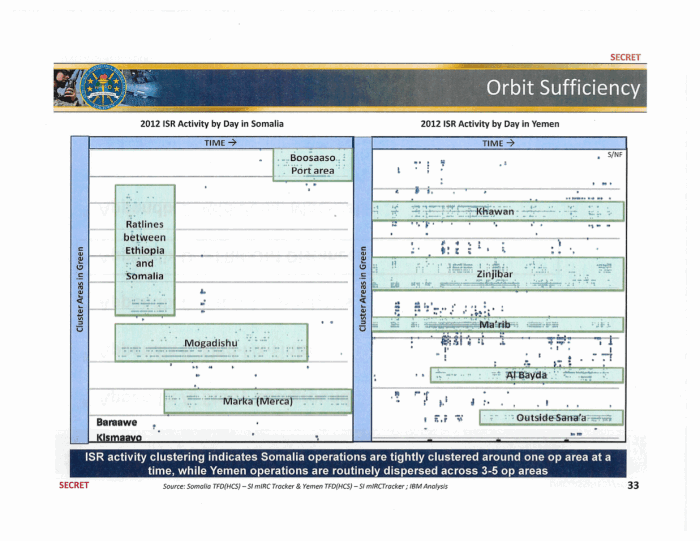
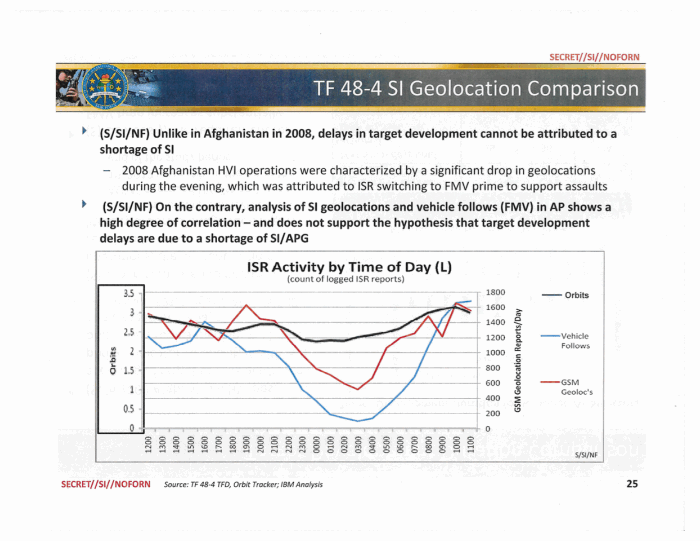
Yet the overall conclusion is that getting accurate positive identification is a“critical” issue for the drone program in the region, due to limitations in technology and the number of spy aircraft available. The military relies heavily on signals intelligence — drawn from electronic communications — and much of it comes from foreign governments, who may have their own agendas.
Identifying the correct target relates directly to the issue of civilian casualties: If you don’t have certainty about your target, it follows that you may well be killing innocent people. In Iraq and Afghanistan, “when collateral damage did occur, 70 percent of the time it was attributable to failed — that is, mistaken — identification,” according to a paper by Gregory McNeal, an expert on drones and security at Pepperdine School of Law.
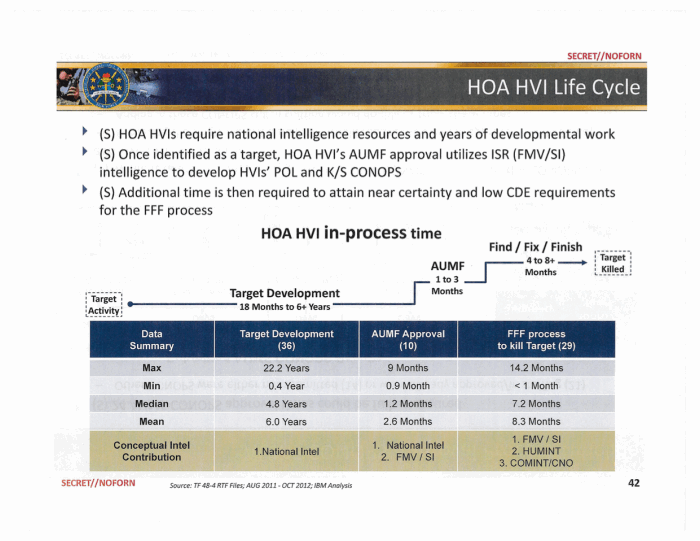
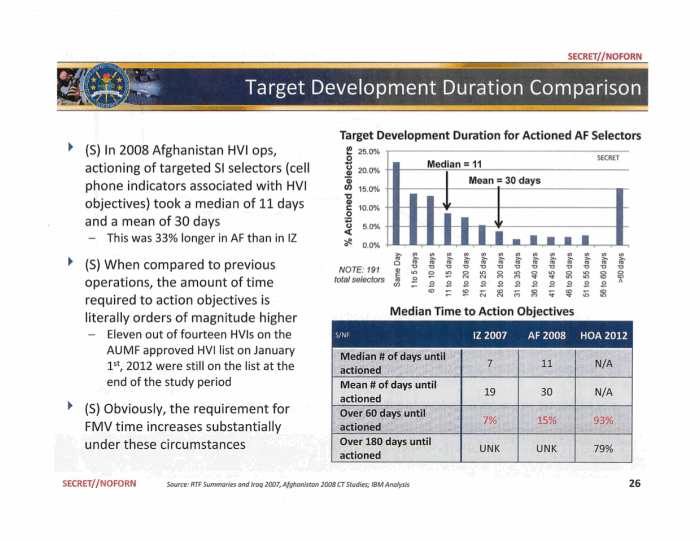
Another factor is timing: If the 60-day authorization expired, analysts would have to start all over in building the intelligence case against the target, said a former senior special operations officer, who asked not to be identified because he was discussing classified materials. That could lead to pressure to take a shot while the window was open.
During the time of the study, there were multiple well-reported, high-profile incidents in which reported JSOC strikes killed the wrong people. Perhaps most famously, in October 2011, a 16-year-old U.S. citizen named Abdulrahman Awlaki, the son of Anwar al Awlaki, died in a JSOC strike while eating dinner with his cousins, two weeks after his father was killed by a CIA drone. In press accounts, one anonymous official called Abdulrahman’s death “an outrageous mistake,” while others said he was with people believed to be members of al Qaeda in the Arabian Peninsula. Publicly, the government has said only that he “was not specifically targeted.”
A September 2012 strike in Yemen, extensively investigated by Human Rights Watch and the Open Society Foundations, killed 12 civilians, including three children and a pregnant woman. No alleged militants died in the strike, and the Yemeni government paid restitution for it, but the United States never offered an explanation.
“The mothers and fathers and brothers and sisters of the people who were killed in these drones strikes want to know why,” said Amrit Singh, senior legal officer at the Open Society Justice Initiative. “We’re left with no explanation as to why they were targeted and in most cases no compensation, and the families are aware of no investigation.”
This spring, in a rare admission of a mistake in targeting, the White Houseannounced that two hostages held by al Qaeda — an American and an Italian — had been killed in a CIA drone strike in Pakistan in January. In attempting to explain the tragedy, the White House spokesperson used the language of the standards that had failed to prevent it: The hostages had died despite “near certainty,” after “near continuous surveillance,” that they were not present.


The Obama assassination complex
From his first days as commander in chief, the drone has been President Barack Obama’s weapon of choice, used by the military and the CIA to hunt down and kill the people his administration has deemed — through secretive processes, without indictment or trial — worthy of execution. There has been intense focus on the technology of remote killing, but that often serves as a surrogate for what should be a broader examination of the state’s power over life and death.
DRONES ARE A TOOL, not a policy. The policy is assassination. While every president since Gerald Ford has upheld an executive order banning assassinations by U.S. personnel, Congress has avoided legislating the issue or even defining the word “assassination.” This has allowed proponents of the drone wars to rebrand assassinations with more palatable characterizations, such as the term du jour, “targeted killings.”
When the Obama administration has discussed drone strikes publicly, it has offered assurances that such operations are a more precise alternative to boots on the ground and are authorized only when an “imminent” threat is present and there is “near certainty” that the intended target will be eliminated. Those terms, however, appear to have been bluntly redefined to bear almost no resemblance to their commonly understood meanings.
The first drone strike outside of a declared war zone was conducted more than 12 years ago, yet it was not until May 2013 that the White House released a set of standards and procedures for conducting such strikes. Those guidelines offered little specificity, asserting that the U.S. would only conduct a lethal strike outside of an “area of active hostilities” if a target represents a “continuing, imminent threat to U.S. persons,” without providing any sense of the internal process used to determine whether a suspect should be killed without being indicted or tried. The implicit message on drone strikes from the Obama administration has been one of trust, but don’t verify.

Photo: The Intercept
 Document
SMALL FOOTPRINT OPERATIONS 2/13
 Document
SMALL FOOTPRINT OPERATIONS 5/13
 Document
OPERATION HAYMAKER
 Document
GEOLOCATION-WATCHLISTThe Intercept has obtained a cache of secret slides that provides a window into the inner workings of the U.S. military’s kill/capture operations at a key time in the evolution of the drone wars — between 2011 and 2013. The documents, which also outline the internal views of special operations forces on the shortcomings and flaws of the drone program, were provided by a source within the intelligence community who worked on the types of operations and programs described in the slides. The Intercept granted the source’s request for anonymity because the materials are classified and because the U.S. government has engaged in aggressive prosecution of whistleblowers. The stories in this series will refer to the source as “the source.”
The source said he decided to provide these documents to The Intercept because he believes the public has a right to understand the process by which people are placed on kill lists and ultimately assassinated on orders from the highest echelons of the U.S. government. “This outrageous explosion of watchlisting — of monitoring people and racking and stacking them on lists, assigning them numbers, assigning them ‘baseball cards,’ assigning them death sentences without notice, on a worldwide battlefield — it was, from the very first instance, wrong,” the source said.
“We’re allowing this to happen. And by ‘we,’ I mean every American citizen who has access to this information now, but continues to do nothing about it.”
The Pentagon, White House, and Special Operations Command all declined to comment. A Defense Department spokesperson said, “We don’t comment on the details of classified reports.”
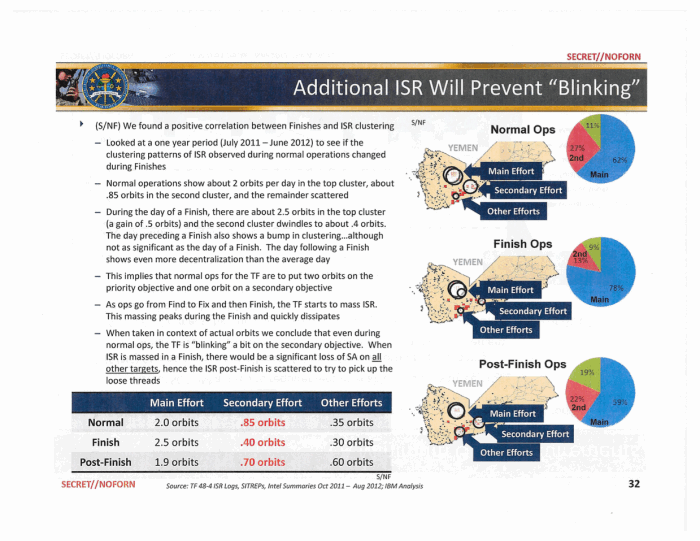
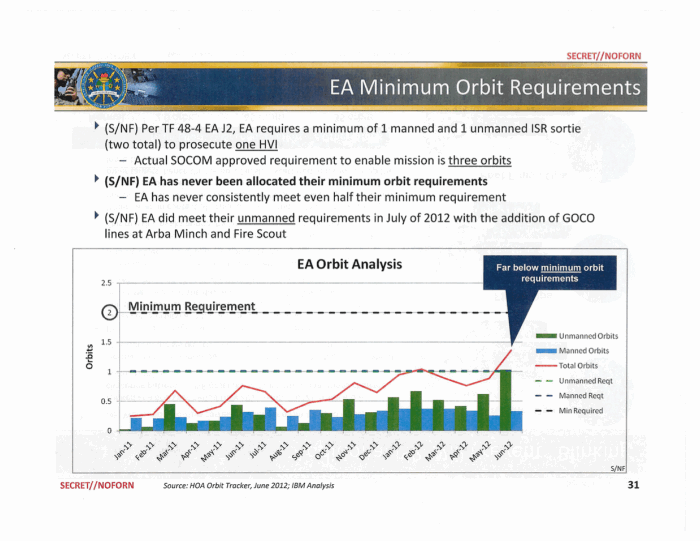
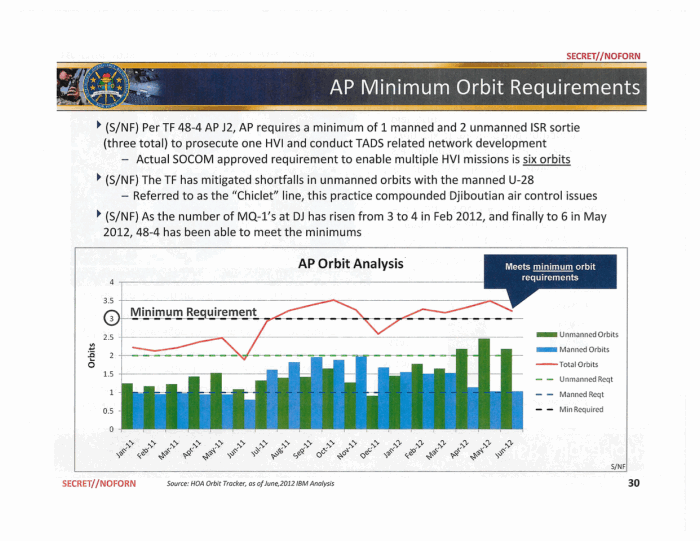
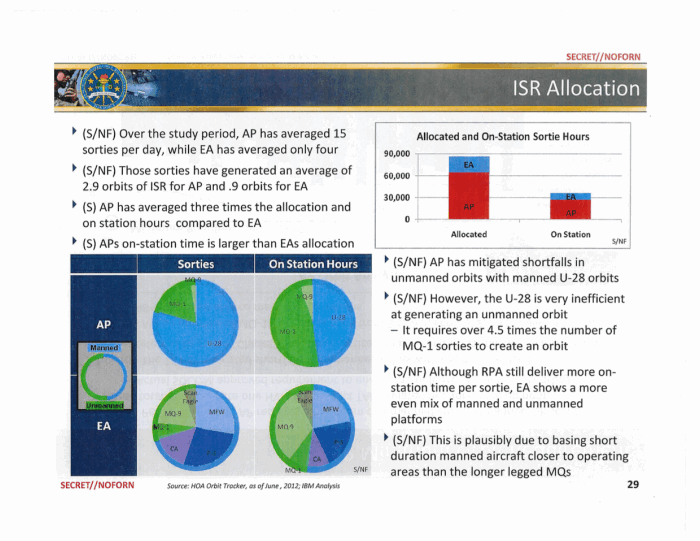
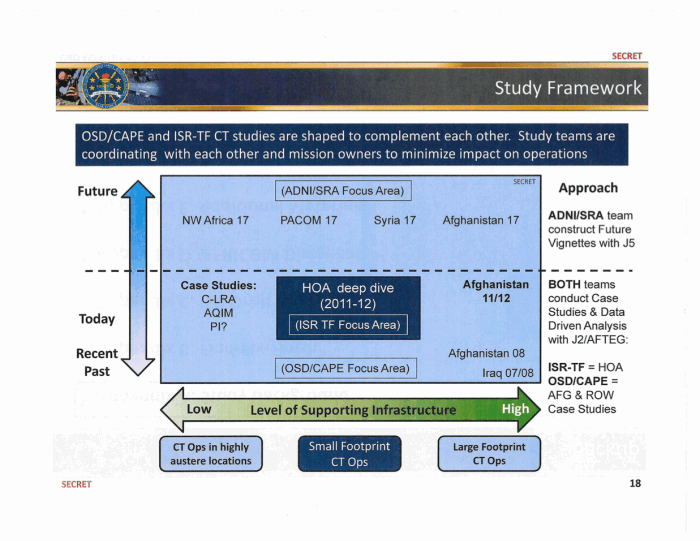
The CIA and the U.S. military’s Joint Special Operations Command (JSOC) operate parallel drone-based assassination programs, and the secret documents should be viewed in the context of an intense internal turf war over which entity should have supremacy in those operations. Two sets of slides focus on the military’s high-value targeting campaign in Somalia and Yemen as it existed between 2011 and 2013, specifically the operations of a secretive unit, Task Force 48-4.
Additional documents on high-value kill/capture operations in Afghanistan buttress previous accounts of how the Obama administration masks the true number of civilians killed in drone strikes by categorizing unidentified people killed in a strike as enemies, even if they were not the intended targets. The slides also paint a picture of a campaign in Afghanistan aimed not only at eliminating al Qaeda and Taliban operatives, but also at taking out members of other local armed groups.
One top-secret document shows how the terror “watchlist” appears in the terminals of personnel conducting drone operations, linking unique codes associated with cellphone SIM cards and handsets to specific individuals in order to geolocate them.

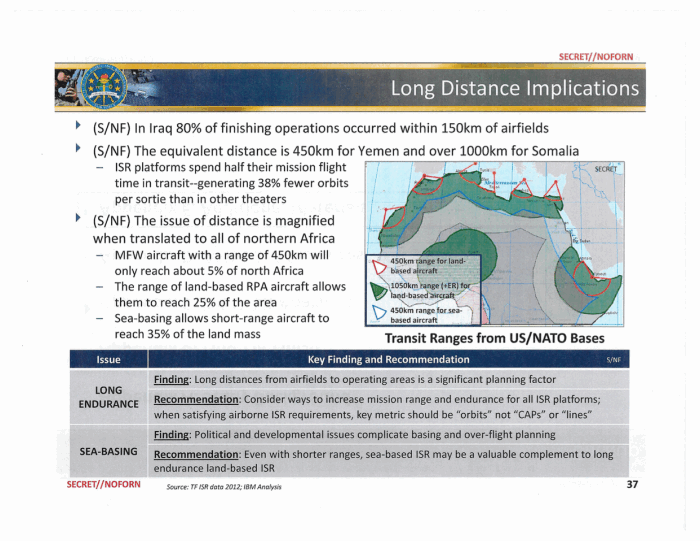
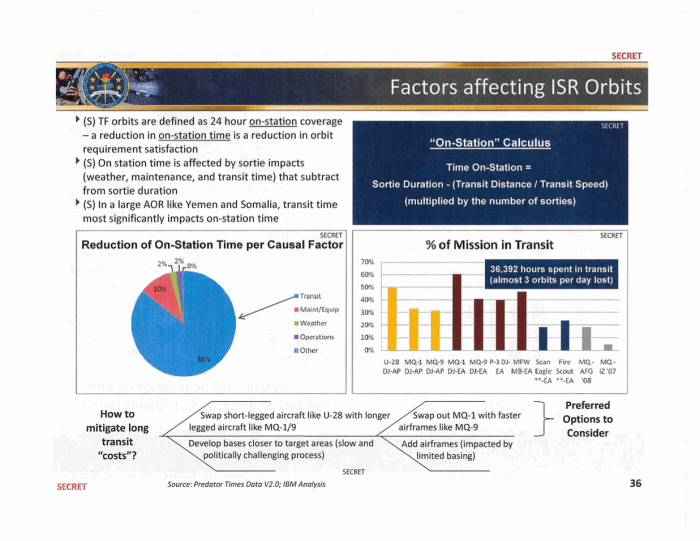
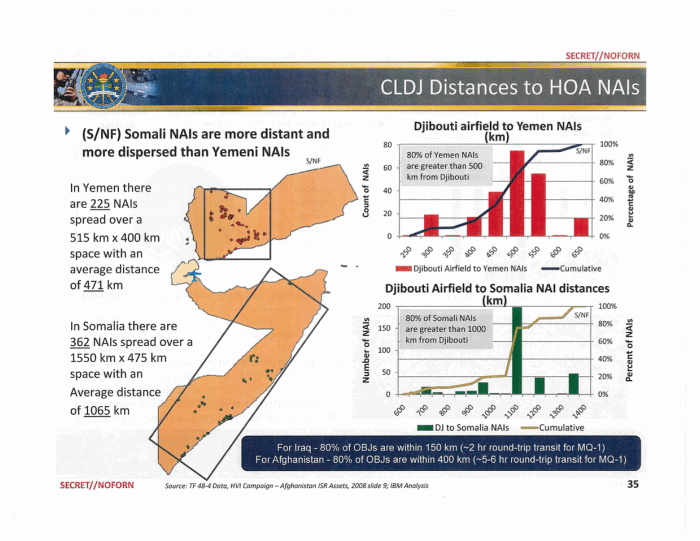
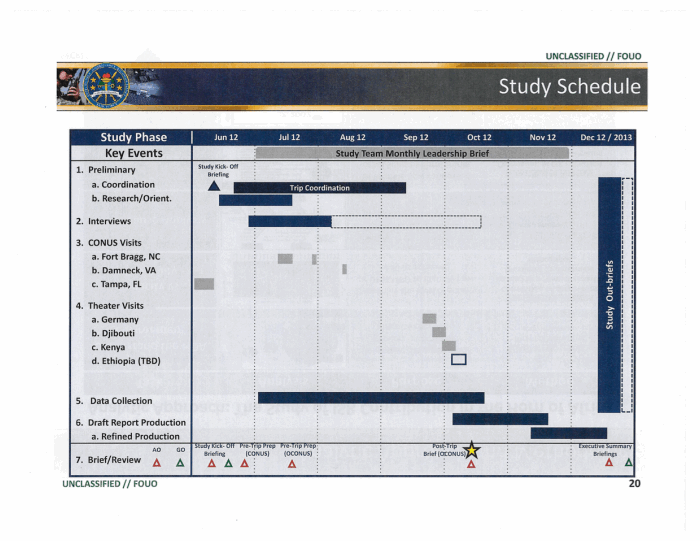
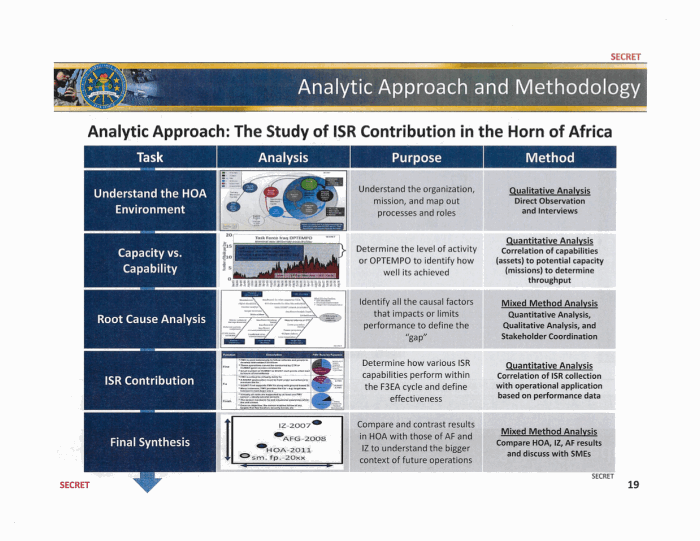
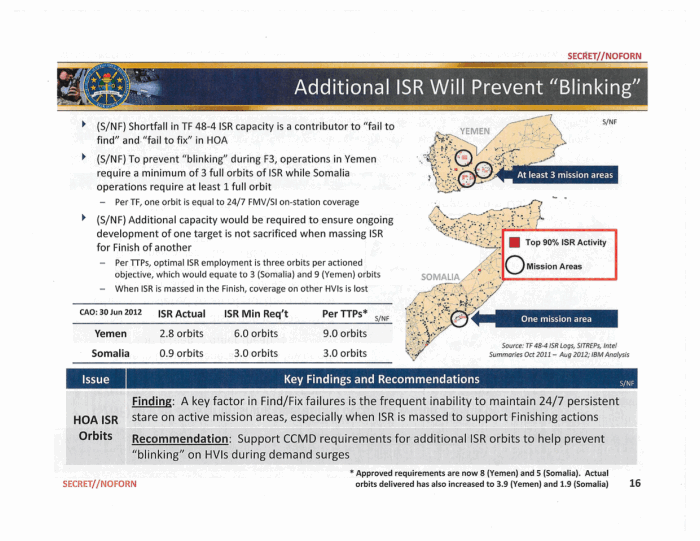
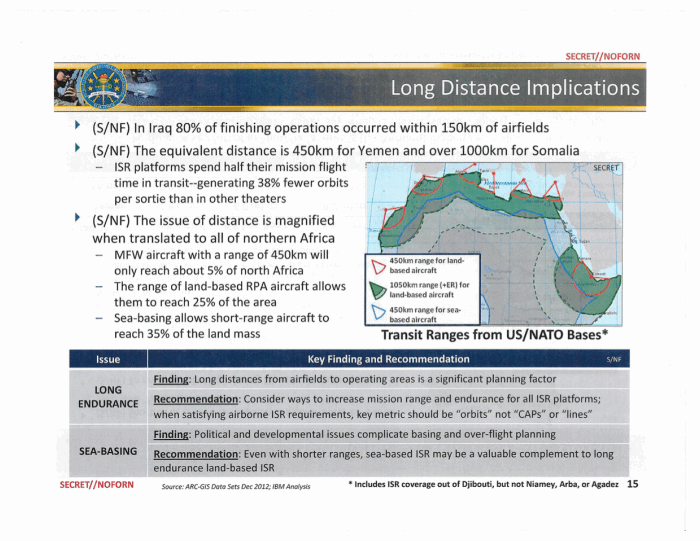
The costs to intelligence gathering when suspected terrorists are killed rather than captured are outlined in the slides pertaining to Yemen and Somalia, which are part of a 2013 study conducted by a Pentagon entity, the Intelligence, Surveillance, and Reconnaissance Task Force. The ISR study lamented the limitations of the drone program, arguing for more advanced drones and other surveillance aircraft and the expanded use of naval vessels to extend the reach of surveillance operations necessary for targeted strikes. It also contemplated the establishment of new “politically challenging” airfields and recommended capturing and interrogating more suspected terrorists rather than killing them in drone strikes.
The ISR Task Force at the time was under the control of Michael Vickers, the undersecretary of defense for intelligence. Vickers, a fierce proponent of drone strikes and a legendary paramilitary figure, had long pushed for a significant increase in the military’s use of special operations forces. The ISR Task Force isviewed by key lawmakers as an advocate for more surveillance platforms like drones.
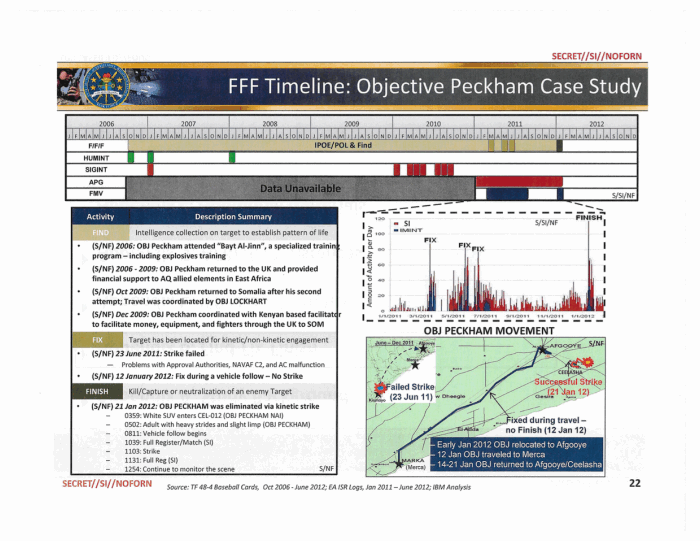
The ISR study also reveals new details about the case of a British citizen, Bilal el-Berjawi, who was stripped of his citizenship before being killed in a U.S. drone strike in 2012. British and American intelligence had Berjawi under surveillance for several years as he traveled back and forth between the U.K. and East Africa, yet did not capture him. Instead, the U.S. hunted him down and killed him in Somalia.
Taken together, the secret documents lead to the conclusion that Washington’s 14-year high-value targeting campaign suffers from an overreliance on signals intelligence, an apparently incalculable civilian toll, and — due to a preference for assassination rather than capture — an inability to extract potentially valuable intelligence from terror suspects. They also highlight the futility of the war in Afghanistan by showing how the U.S. has poured vast resources into killing local insurgents, in the process exacerbating the very threat the U.S. is seeking to confront.
 Read more
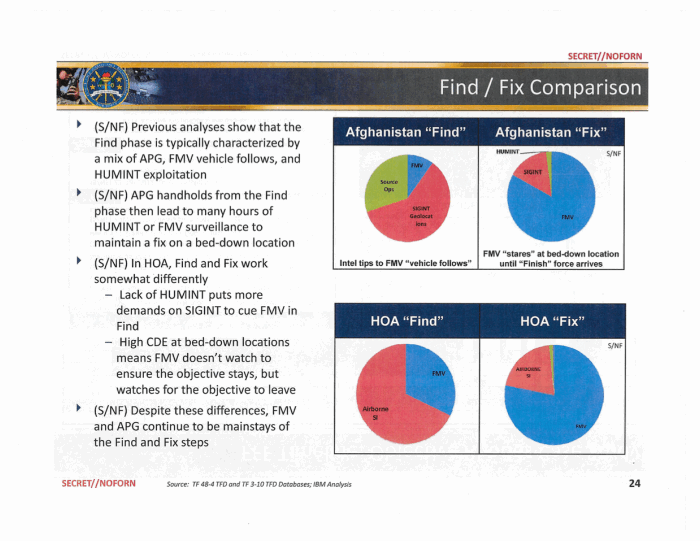
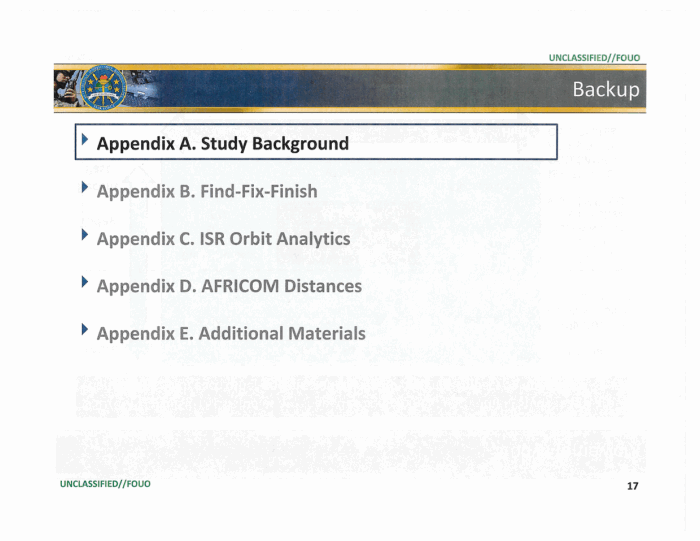
FIND, FIX, FINISHThese secret slides help provide historical context to Washington’s ongoing wars, and are especially relevant today as the U.S. militaryintensifies its drone strikes and covert actions against ISIS in Syria and Iraq. Those campaigns, like the ones detailed in these documents, are unconventional wars that employ special operations forces at the tip of the spear.
The “find, fix, finish” doctrine that has fueled America’s post-9/11 borderless war is being refined and institutionalized. Whether through the use of drones, night raids, or new platforms yet to be unleashed, these documents lay bare the normalization of assassination as a central component of U.S. counterterrorism policy.
“The military is easily capable of adapting to change, but they don’t like to stop anything they feel is making their lives easier, or is to their benefit. And this certainly is, in their eyes, a very quick, clean way of doing things. It’s a very slick, efficient way to conduct the war, without having to have the massive ground invasion mistakes of Iraq and Afghanistan,” the source said. “But at this point, they have become so addicted to this machine, to this way of doing business, that it seems like it’s going to become harder and harder to pull them away from it the longer they’re allowed to continue operating in this way.”
https://theintercept.com/drone-papers/the-assassination-complex/
יום ראשון, 20 בספטמבר 2015
Iran Secret Negotiations With U.S. Began In 2011
Iranian Officials Reveal That Secret Negotiations With U.S. Began In 2011 – Only After U.S. Complied With Tehran's Precondition To Recognize In Advance Iran's Nuclear Status
Introduction
American administration spokesmen have explained the nuclear agreement with Iran as both leveraging the opportunity created by the election of a pragmatic Iranian president, Hassan Rohani in June 2013, and as vital because the sanctions have not set back Iran's nuclear program, and the West has grown weary of enforcing them.[1]
However, it has emerged that the U.S. began secret negotiations even earlier, in 2011, during the presidency of the extremist Mahmoud Ahmadinejad. Moreover, during that time, not only had the Western countries not lost interest in maintaining the sanctions, but they had intensified them significantly after the beginning of the secret negotiations – both in March 2012, when sanctioned Iranian banks were disconnected from the SWIFT system, and in July 2012, when the European sanctions on Iranian oil sales were imposed.
Furthermore, according to recent reports in Western media from Western sources, the Obama administration had, since President Obama took office in 2008, constantly and consistently pushed for negotiations with Iran. President Obama's messages in this regard to Iran's leadership on various levels – letters, public speeches, and so on – began as early as 2009; details of these media reports and of Obama's messages will be published in a separate MEMRI report.
Additionally, it is evident from statements by top Iranian officials that the secret contacts initiated by the Obama administration with Iran did indeed begin in 2011, during the extremist Ahmadinejad's presidency – before harsh sanctions were imposed.
This paper will present the Iranian narrative, as related by senior Iranian regime officials, about the beginning of the secret contacts between the U.S. and Iran that ultimately led to the announcement of the JCPOA in July 2015:
Khamenei: Bilateral Talks Began In 2011, And Were Based On U.S. Recognition Of A Nuclear Iran
In a June 23, 2015 speech, Iranian Supreme Leader Ali Khamenei told about the American initiative, saying that it had begun during the Ahmadinejad presidency and had centered on U.S. recognition of a nuclear Iran: "The issue of negotiating with the Americans is connected to the term of the previous [Ahmadinejad] government, and to the dispatching of a mediator to Tehran to request talks. At that time, a dignified individual from the region [referring to Omani Sultan Qaboos] came to visit me as a mediator, and said explicitly that the American president [Obama] had asked him to come to Tehran and present the Americans' request for negotiations. The Americans told this mediator: 'We want to solve the nuclear issue and lift sanctions within six months, while recognizing Iran as a nuclear power.' I told this mediator that I did not trust the Americans or their words, but I agreed, when he persisted, to reexamine this issue, and the negotiations began."[2]
Rafsanjani: Two Meetings Were Held Prior To Iran's 2013 Presidential Election
Pragmatic camp leader Hashemi Rafsanjani stated in an August 4, 2015 speech that contacts between the Americans and Iranians date back to the Ahmadinejad era: "A few months prior to the [2013] elections in Iran, high-ranking regime officials agreed that there should be negotiations with America. Before this, an [Iranian] team had been sent to Oman in light of a message from Sultan Qaboos, and two lengthy meetings were held [there]."[3]
Salehi: "As A Senator, Kerry Had Been Appointed By Obama To Be In Charge Of Handling The Nuclear Dossier, And Then [In December 2012] He Was Appointed Secretary Of State"
Salehi In April 2014: I Jumpstarted The Talks With The U.S., During Ahmadinejad's Term, With Khamenei's Approval
In an April 19, 2014 interview, Iranian Atomic Energy Organization director Ali Akbar Salehi, who served as foreign minister under Ahmadinejad, told Iran's Al-'Alam TV:
"Regarding negotiations with America, I first went to the leader [Khamenei] to request his permission [to negotiate], and he set the condition that we would discuss only the nuclear issue. At that time, we started our work. Work on the talks with America began two and a half years ago [that is, during 2011], after obtaining the leader's approval, and later the matter was transferred to the next government [i.e. the Rohani government]. At that time, the leader ordered [us to] ask several officials in the previous [Ahmadinejad] government for their view regarding bilateral talks with the American administration on the nuclear issue. I was at the foreign ministry back then, that is, two or three years ago, and I said these things to the leader and [I also] said, 'Allow us to enter into negotiations with the Americans on the nuclear issue.' He said that they [the Americans] are not to be trusted, and provided proof of this, such as the issues of Afghanistan and Iraq, and added that they [the Americans] violate commitments and alliances, are untrustworthy, and do not have good intentions.
"I told him: 'If you permit it, we can make an attempt on the nuclear issue as well.' He said: 'No problem. Go ahead. But know that this [i.e. these talks] will be an ultimatum [for them]. We will inform the [Iranian] people that we have used every opportunity to peacefully resolve this issue with honor and wisdom, and as part of our interests, and that we will prevent them [the Americans] from playing with [Iranian] public opinion.' Setting several conditions, [Khamenei] said: 'You must obey four conditions, and one of them is that the talks will concern only the nuclear issue.' Ultimately, the matter somehow began, and arrived to [the hands of] the new [Rohani] government, which continued it."[4]
Salehi In April 2015: "Representatives Of America Said That They Officially Recognize [Iran's Right To] Enrichment.' This Was The First Step, That Opened The Door To The Negotiations"
A year after these statements to Al-Alam TV, Salehi reiterated, on April 21, 2015, to reformist circles the bilateral U.S.-Iran negotiations had come about:[5]
"When I was foreign minister [in the Ahmadinejad government], I came to Khamenei and asked him to examine a different path. At that time, the Americans had sent us their offer via Oman. Noticing the gravitas of the Americans during the [general P5+1] talks, I asked the leader to allow us to examine a second path.
"Noting America's record, he said: 'America breaks promises.' I said: 'Let me jumpstart negotiations in order to set an ultimatum [and that is this]: If we do not reach an outcome, it will be clear that it is the other side [i.e. the U.S.] that is intractable. Khamenei agreed to these talks, and set conditions. One of them was that these would not be negotiations for their own sake – that is, the Americans must not stall. Another condition was that the talks would focus only on the nuclear issue, not on bilateral ties or any other issues... Of course, the Americans insisted that these talks take place prior to their [2012 presidential] election. Following unofficial correspondence with them via Oman, the talks began late.
"Eventually, we held the first round [of talks]. At that time, [Iranian Deputy Foreign Minister] Khaji was sent to head the talks, accompanied by several desk chiefs. In this round, we reached a series of initial agreements, but the second round was postponed due to this lack of coordination [within the Ahmadinejad government]. No matter how hard we pressed, the work did not progress. Eventually, the second round took place, and this is all documented.
"History will judge the correspondence between us, and the defective morality [on the American side] in the process, for which there is documentation. In the Ahmadinejad government, I gave an interview in which I stated, after I had received permission [to do so], that we will soon witness good events. I thought we could move ahead in these talks easily, and I did not know that we would hit a roadblock. Happily, in the second round of talks, the Sultan of Oman wrote to Ahmadinejad: 'The American and Iranian representatives came to me and the representatives of America said that they officially recognize [Iran's right to] enrichment.' This was the first step, that opened the door to the negotiations.
"After that, the desired framework for continuing the negotiations was clarified. These events led to us reaching a third round of talks, held just prior to the [June 2013] Iranian presidential elections. We had wasted so much time and energy on each previous round of talks, which is why the negotiations took so long, but the result was that the Americans themselves undertook to notify the P5+1 that an agreement with us had been reached, since we ultimately must arrive at an outcome by means of that group [i.e. the P5+1].
"On the eve of the third round of negotiations, Khamenei wished to transfer responsibility for the negotiations to the next [i.e. Rohani] government. Ultimately, when the Rohani government began to operate, I came to His Honor [likely Rohani] and presented a report on the ongoing work. He saw the process of implementation as worthy of attention. The Rohani government established a political committee comprising [Foreign Minister Javad] Zarif and several presidential advisors. I asked [Deputy Foreign Minister] Khaji [who had conducted the secret negotiations] and [Deputy Foreign Minister Abbas] Araghchi [and senior negotiator] to update the committee [on the negotiations]. To my delight, the Rohani government opened the door [to negotiations], because of [their] comprehensive sympathy and cooperation. The president [Rohani], foreign minister [Zarif], and Supreme National Security Council secretary [Ali Shamkhani] were all in agreement, and this advanced matters rapidly...
"Without a doubt, it was Khamenei personally who opened the door to this process. I just played the role of go-between."[6]
Salehi In Extensive August 2015 Interview: Kerry, As Head Of The Senate Foreign Relations Committee, Sent Tehran A Letter Recognizing Iran's Right To Enrich Uranium
In a far-ranging interview published in the daily Iran on August 4, 2015, Salehi revealed further details (for the rest of the interview, see MEMRI Special Dispatch No. 6134, Iranian VP And Atomic Chief Salehi Reveals Details From Secret Iran-U.S. Nuclear Talks: Khamenei Made Direct Talks Conditional Upon Achieving Immediate Results; U.S. Conveyed Its Recognition Of Iran's Enrichment Rights To Omani Sultan, Who Relayed The Message To Then-President Ahmadinejad, August 17, 2015):
"...All the demands in the letter were related to the nuclear challenge. These were issues we have always come against, such as closing the nuclear dossier [in the Security Council], official recognition of [Iran's] right to enrich [uranium], and resolving the issue of Iran's actions under the PMD [Possible Military Dimensions]. After receiving the letter, the Americans said: 'We are certainly willing and able to easily solve the issues Iran has brought up.'
"Q: With whom was the American side in contact?
"A: They were in contact with Omani officials, including the relevant functionary in the Omani regime. He was a friend of the U.S. secretary of state [John Kerry]. At that time, Kerry was not secretary of state, but head of the Senate Foreign Relations Committee. In any case, after I received an affirmative answer from the Americans, I deduced that the ground was prepared for further steps in this direction. That is why I asked the Omanis to send an official letter to Iran so I could present it to Iranian officials. I assessed that this was a good opportunity and that we could derive benefit from it.
"Q: Up to this point, you hadn't consulted with anyone? You were acting solely on your own authority?
"A: Yes. I sent a message to Omani officials saying, 'Write your letter in an official manner so that our officials will know that it is serious.' That was because up to that point, all discussions had been strictly oral. I told our Omani friends: 'Present these demands officially.' They did so, and I presented the letter to [Iranian] regime officials and went to the leader [Khamenei] to explain the process in detail.
"Q: Did you also give the letter to the president [Ahmadinejad]?
"A: I informed regime officials that such a letter had been received. After the letter [was received], I went to the leader and told him, 'It is unlikely that talks between Iran and the P5+1 will achieve the results we desire. If you permit it, I can promote another path [meaning a secret bilateral channel with the U.S.].' I later informed him that Oman was officially willing to act as official mediator...
Q: Did the Supreme National Security Council play a part in these [secret] talks?
"A: No. I was authorized to advance these talks but I had to coordinate with the other bodies, which is exactly what caused problems. Eventually, after receiving the leader's approval, eight months after the necessary coordination was achieved with the head of the Supreme National Security Council [Saeed Jalili], the first meeting with the Americans was held. We sent a team to Oman that included the deputy foreign minister for European and American affairs, Mr. [Ali Asghar] Khaji, as well as several CEOs. The Americans were surprised in the first meeting and said, 'We cannot believe this is happening. We thought Oman was joking. We aren't even prepared for these talks with you.'
"Q: What was the level of the team that the Americans dispatched?
"A: It included Assistant Secretary of State William Burns. They said: 'We only came to see if Iran was truly willing to negotiate.' Our representative gave them the required response and eventually there were talks on this issue. The initial result was achieved and the ground was prepared for further coordination.
"Q: How were the Americans convinced that the Iranian diplomats who were dispatched had the necessary authority?
"A: [Until] that phase, Iran and America had not been allowed to sit opposite each other at the negotiating table. The fact that Iran had sent a deputy foreign minister to the talks indicated its seriousness. The Americans also noticed how seriously [Iran was taking] the issue. At that meeting, Khaji pressed the Americans to set up a roadmap for the negotiations, and eventually the talks of a roadmap were postponed to the second meeting. At the second meeting, Khaji warned the Americans: 'We did not come here for lengthy negotiations. If you are serious, you must officially recognize enrichment, otherwise we cannot enter into bilateral talks. But if you officially recognize enrichment, then we too are serious and willing to meet your concerns on the nuclear matter as part of international regulations.'
"Q: What [Iranian] body backed this demand?
"A: The Foreign Ministry, since the leader gave me guidelines [as foreign minister] and stressed, 'First you must promote important demands such as official recognition of enrichment rights.' We determined that this issue would be a criterion [for determining whether the talks would continue]. We told ourselves that if they postponed recognition of enrichment to the final stage [of the talks], they would turn out to be unserious and these talks would be fruitless...
Q: You have said that the negotiations started during Obama's first term. Did you consider the possibility that Obama's rival would be elected president and would reject Obama's reassessment of Iran, and that the White House would continue the same inflexible hostility?
"A: No, on the contrary, [although] at that time the race between Obama and Romney was very close, [and] in some polls Romney was even ahead of Obama. [But] the Americans intended to push for good terms in the negotiations with all possible speed. In fact, there was a good atmosphere for talks...
"Of course, at that time we were [still] exchanging various information with the Americans via the [Omani] mediation, and this is documented at the Foreign Ministry. We did not do it in the form of official letters, but rather unofficially and not on paper. The Omani mediator later came to Iran, held talks with us, and then later spoke to the Americans and told them our positions, so that the ties were not severed. But there was no possibility for direct talks.
"Thus, a real opportunity was squandered because, at the time, the Americans were genuinely prepared to make real concessions to Iran. Perhaps it was God's will that the process progressed like that and the results were [eventually]in our favor. In any case, several months passed and Obama was reelected in America [in November 2012]. I thought that, unlike the first time, we must not waste time in coordinating [within regime bodies], so with the leader's backing and according to my personal decision, I dispatched our representatives to negotiate with the Americans in Oman...
"I dispatched Khaji to the second meeting in Oman (around March 2013) and it was a positive meeting. Both sides stayed in Oman for two or three days and the result was that the Omani ruler sent a letter to Ahmadinejad saying that the American representative had announced official recognition of Iran's enrichment rights. Sultan Qaboos sent the same letter to the American president...
"We had received [this] letter from Sultan Qaboos that stated the Americans had committed to recognizing Iran's enrichment rights. We [then ] prepared ourselves for the third meeting with the Americans in order to set up the roadmap and detail the mutual commitments. All this happened while Iran was nearing the presidential elections [in June 2013]...
"Q: What was the Americans' position in the first meetings between Iran and the P5+1 held during the Rohani government [era]?
"A: After the Rohani government began to operate – along with the second term of President Obama – the new negotiations between Iran and the P5+1 were started. By then, Kerry was no longer an American senator but had been appointed secretary of state. As a senator, Kerry had been appointed by Obama to be in charge of handling the nuclear dossier, and then [in December 2012] he was appointed secretary of state.
"Before that, the Omani mediator, who had close relations with Kerry, told us that Kerry would soon be appointed [U.S.] secretary of state. During the period when the secret negotiations with the Americans were underway in Oman, there was a situation in which it was easier to obtain concessions from the Americans. After the Rohani government and the American administration [of Obama's second term] took power, and Kerry become secretary of state, the Americans spoke from a more assertive position. They no longer showed the same degree of eagerness to advance the negotiations. Their position became harder, and the threshold of their demands rose. At the same time, on the Iranian side, the situation [also] changed, and a most professional negotiating team took responsibility for negotiating with the P5+1."
Irannuc.ir: Talks Began During Ahmadinejad Presidency; America Sent Iran A Letter
On April 20, 2014, the pro-ideological camp website Irannuc.ir, which is affiliated with the Iranian nuclear negotiating team from the Ahmadinejad era, published a report on the bilateral U.S.-Iran negotiations during the Ahmadinejad era. The report was subsequently removed from the site, but was republished the same day by the website Alef.ir.
Irannuc.ir reported: "Two additional conditions, of the four [set by Khamenei], were that the foreign minister himself [Salehi] would not attend the talks, and that the negotiations would have results that are concrete and early. The policy for these talks was set by a committee of three regime officials, but Ahmadinejad himself played no significant role in it. The main strategy of the negotiations was [to set] an ultimatum for America and to show its dishonesty and unreliability. By the time of the 2013 [Iranian] presidential elections, three rounds of talks had taken place in Oman, and the Americans had officially acknowledged Iran's [right] to enrich [uranium]. However, after the new [Rohani] government came to power, the [Americans] perceived [this government's] haste and its motivation to reconcile [with the U.S.], and [therefore] they backtracked and, in the Geneva agreement, denied this right.
"America informed Iran, in a written letter, about the issue of accepting [Iran's right] of enrichment. In those negotiations, the modalities were nearly finalized, and a finish line was set that differed greatly from the one agreed on in [the] Geneva [Plan of Action, November 2013].
"At that time, the main responsibility for the negotiations was in the hands of one of the [Iranian] foreign minister's skilled deputies. The Rohani government did not appreciate the technical achievements of the previous [Ahmadinejad] government, and traded them for meager [returns]; it also did not appreciate the cumulative [accomplishments] of the [secret] negotiations, in the New York negotiations [on the margins of the 2013 UN General Assembly], and in the Geneva agreement, [the Rohani government] operated in a way that led to an outcome that was very different than what the Americans had agreed to just a few months earlier, and that is not in line with Iran's interests. Joe Biden's [national security] advisor Jack Sullivan and Undersecretary of State Bill Barnes participated in these [secret] talks."[7]
Majlis Speaker's Advisor: John Kerry Sent Iran A Letter, Via Oman, Recognizing Iran's Right To Enrich Uranium
In a July 7, 2015 interview with Tasnim, Majlis Speaker Ali Larijani's advisor Hussein Sheikh Al-Islam also discussed the contacts and meetings that had preceded the start of the U.S.-Iran negotiations, and added that Kerry had sent Tehran a letter recognizing Iran's right to enrich uranium: "We came to negotiate [with the U.S.] after Kerry wrote a letter and sent it to us via Oman, stating that America officially recognizes Iran's rights regarding the [nuclear fuel] enrichment cycle. Then, there were two meetings between the deputy foreign ministers in Oman, and after those, Obama sent Sultan Qaboos with Kerry's letter to Khamenei. Khamenei told him: 'I don't trust them.' Sultan Qaboos said: 'Trust them once more.' It was on this basis that the negotiations began, and not on the basis of sanctions, as they [the Americans] claim in their propaganda..."[8]
* A. Savyon is director of the MEMRI Iran Media Project; Y. Carmon is President of MEMRI; Y. Mansharof is a MEMRI Research Fellow.
Endnotes:
[1] According to administration officials, primarily President Obama himself, the U.S. only began secret talks with Iran after the election of Hassan Rohani, from the pragmatic camp, as Iran's president. See President Obama's speech at American University, August 5, 2015.
[2] Leader.ir, June 23, 2015. Ahmad Khorshidi, a relative of Ahmadinejad's, told the website Entekhab in 2014 that negotiations between Tehran and Washington did not start during President Rohani's term. He said that during the Ahmadinejad era, there were three rounds of talks between the sides, which were also attended by then-foreign minister Ali Akbar Salehi. Entekhab.ir, June 11, 2014.
[3] ISNA (Iran), August 4, 2015.
[4] Al-'Alam (Iran), April 19, 2014.
[5] Salehi also repeated this in an interview with Iranian TV in April 2015, and said that during his term as foreign minister in 2011-2012, he had suggested to Khamenei to start negotiations with the Americans. According to him, there were two rounds of talks in Oman that led to Sultan Qaboos dispatching a letter to Ahmadinejad stating that the Americans officially recognize Iran's right to uranium enrichment. Entekhab.ir, April 26, 2015.
[6] Parsnews.com, April 21, 2015.
[7] Irannuc.ir, April 20, 2014. The report was also published on the same day by Alef.ir.
[8] Tasnim (Iran), July 7, 2015.
הירשם ל-
רשומות (Atom)